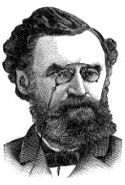
 | "Ideals are like stars; you will not succeed in touching them with your hands, but like the seafaring man on the desert of waters, you choose them as your guides, and following them, you reach your destiny." -Carl Schurz |
GERMAN-AMERICANS AND THE SLAVERY ISSUEFacsimiles of the First Public Protest against Slavery in North America |
1688: The earliest protest against Negro slavery in American history was that of the Germantown settlers, whose leader Francis Daniel Pastorius drew up the document. In addition, the German Salzburgers of Georgia, the Germans of the Valley of Virginia, and the Moravians of North Carolina resisted the keeping of Negro slaves as long as was possible.
Howard B. Furer, The Germans in America 1607-1970. (Dobbs Ferry, New York: 1973), Oceana Publications, Inc., p.2
The pious Krefelders who had accepted William Penn's invitation and arrived in Pennsylvania in 1683 aptly called their place Germantown, today a part of Philadelphia. After initial hardships, the guidance provided by Francis Daniel Pastorius, their organizer and first mayor, and the skills of carpenters, weavers and tailors created a prosperous community that grew with new arrivals. As early as 1684, Pastorius set up the first country fair in Philadelphia. The Krefelder's cloth then soon found markets in Boston and New York.
Ten years after its founding, the "German Township" covered 5,700 acres, divided into four sections: Germantown; Kriegsheim--named after the Palatine Quaker's home; Sommerhausen--after Pastorius' Franconian birthplace; and Crefeld--from where the majority of the settlers had come. Recalling their difficult beginnings, Pastorius wrote that some equated their "Germantown" with "Armentown" (town of the poor).
Closely connected to the growing importance of Germantown was William Rittenhouse [Wilhelm Rittenhaus], a 1686 arrival. This first elected Mennonite pastor and bishop also made economic history by founding America's first paper mill (1690). His paper was then also used by another famous Germantowner, Christopher Saur, the printer of the first American Bible (1743). This 1,272 pp. German volume antedates by 40 years the printing of the first English-language Bible in America. The versatile Saur also manufactured printing type and ink, invented optical instruments, improved cast iron stoves, and succeded Ben Franklin's shortlived German-language newspaper with his Hoch Deutsch Pennsylvanischer Geschicht Schreiber (1739).
Pastorius and his Germantowners were appalled by the incompatibility of slavery with Christianity. They are credited with the first protest against Negro slavery as early as 1688. Even though this did not change the fate of Afro-Americans in general, it set the standard for German religious communities. None of them would ever engage in slave-holding, and almost all secular German communities lived up to the Germantown declaration as well.
By Profs. E. Reichmann and LaVern J. Rippley in Bert Lachner, Heimat North America, (Glen Ellyn, IL:1997) Landmark Books Unlimited, p. 17
The settlers to Germantown came from the Lower Rhine where German and Dutch cultural ways mingled. These thirty-three settlers from Krefeld, Germany who established the first sizable, stable and distinctly German settlement in America at Germantown, PA in 1683, followed more than seven million immigrants to our shores from German-speaking countries. The city of Krefeld west of the Rhine near Duesseldorf, known for the manufacture of silk and linen, prided itself on being a haven of tolerance during the 17th century, and a refuge for those suffering religious oppression. When changes in the rule of the region caused the spirit of religious acceptance to diminish, some among the Mennonite and Quaker families decided to accept the invitation of William Penn to settle in America.
The English Schooner which brought these German settlers to the port of Philadelphia was named the Concord, an appropriate symbol of the immigrants' friendly cooperation with the English and Dutch aboard. All the passengers, attached to religious groups outside the established churches, answered the call of William Penn to share the "Holy Experiment" and settle on the land granted to William Penn's father for his services to the English crown.
When the thirteen Mennonite families from Krefeld landed in Philadelphia on October 6, 1683 after a 75-day voyage, they were greeted not only by Penn but also be a young, 32-year old German lawyer, Francis Daniel Pastorius, who had become close friend wit h Penn since his arrival on August 20, 1683 on the ship America with about a dozen people, among them his personal servants.
When Pastorius, a well traveled scholar, had heard about Penn's visits to the Rhineland in 1671 and 1677 to recruit a group of religious and affluent Pietists, he decided to associate himself with the group. But plans with the Frankfurt Land Company did n ot materialize. Instead, Pastorius became the leader of thirteen more modest families, who wished to escape religious intolerance, and settle where they could lead a quiet and god-fearing life, free from religious controversy and with the promise of liber ty. That place was to be Germantown, PA.
Pastorius arranged with Penn for the Krefelders to settle on a parcel of land six miles north of newly founded Philadelphia. Cellers were dug into the ground and covered and these were their shelters for the first winter. Even though that winter brought m any hardships, the new settlers endured. The nickname for the new town, "Armentown" (town of the poor) was soon made obsolete by their hard work and skills in the trades of weaving, tailoring, carpentry, and shoemaking.
They built homes first of logs and later of native stone; they raised flax, built looms and set up their spinning wheels. Many were accustomed to growing vines and when they saw wild grapes, they establishing vineyards. The official seal of Germantown bea rs at its center a trifolium having a grape vine on one leaf, flax blossoms on another and a weaver's spool on a third with the inscription "Vinum, Linum et Textrinum," to show that the people lived from grapes, flax, and trade. The Germantown Fair, first held in 1701 became a center of exhibiting and selling the products of these craftsmen.
Penn had advised the new settlers not to reside on scattered farms, but to follow the European pattern of living together in a town. By the end of the 1600s Germantown had a wide Main Street bordered by peach trees, a central market and on opposite ends of town were burial grounds. Along the several streams were a number of mills. More than fifty families built spacious farm buildings and tended their three acre town plots growing vegetables and flowers. The fields of the town lay to the north and south. These Germans had a love and respect for the land unequaled by other immigrants and so they gained the reputation for caring for the land exceedingly well.
In a few years the population of Germantown had increased so that additions were made: Kriegsheim with 884 acres (named for the home of the Palatine Quakers), Sommerhausen with 900 acres (in honor of Pastorius' birthplace), and Crefeld with 1166 acres were added to the 2750 acres of Germantown. All were on the same road; Germantown was the nearest to Philadelphia and Crefeld was beyond Chestnut Hill in present Montgomery County.
On August 12, 1689 Germantown was incorporated and its first burgomaster, Pastorius, made many lasting contributions to the community. Among them he is credited with the establishment of a school system in which he became a teacher. Since Mennonites considered education important, school houses were often built first with worship held there until meetinghouses could be built. Another of Pastorius's contributions was the writing of the first resolution in America against Negro slavery*. As Germantown prosp ered, its administration, founded on self government and civic responsibility, became a model for later German settlements in America.
In 1883 America remembered the Germantown settlement and on Thanksgiving, November 29, 1884 William Penn's statue was completed in Philadelphia. Today one can visit the rebuilt home of Penn called Pennsbury Manor which is about 26 miles from Philadelphia.
In 1983 ceremonies were held throughout the U.S. to commemorate the first organized settlement and books were published to tell the story of German-American involvement in the founding and development of America. The U.S. and Germany issued postage stamps of the ship Concord to salute the courage, stamina, and motivation of those immigrants and all who followed in their footsteps.
On this 300th anniversary of the arrival of the German pioneers the home of the father of Franz Daniel Pastorius in Germany was acquired by the Pastorius Home Association. The historic building was restored to its original charm by a combined, voluntary effort of German and American citizens. It contains a lecture hall, library, and facilities for guests. The home is open all year round for travelers, and educational programs are scheduled throughout the year.
Since 1983 several landmarks in Germantown have been restored, among them Rittenhouse Square which marks's America's first paper mill, established by Wilhelm Rittenhouse in 1690. A U.S. postcard was also issued showing the Rittenhouse mill.
In 1988, under the leadership of the Greater Germantown Housing Development Corporation, the Germantown community initiated a comprehensive economic development program for the area which was suffering urban decay. Plans called for the renovation of the 4 9 houses along Germantown Avenue and the creation of new job-producing enterprises in the neighborhood. In the center was to be a town square and historic park dedicated to the 1688 slavery protest and to the thirteen pioneer families. It was also fitting that thirteen "family trees" were planted.
On a marker, previously placed for the families in Germantown, is written: In commemoration of the Landing of the German Colonists, October 6, 1683, FRANZ DANIEL PASTORIUS, Dirk, Herman, Abraham Op Den Graeff*, Tuenes Kunders, Lenert Arens, Reinert Tisen, Wilhelm Strepers, Jan Lensen, Peter Keurlis, Jan Siemens, Johann Bleikers, Abraham Tuenes and Jan Lueken with their families.
* Betty Randall is a descendant of Abraham op den Graeff, one of the original Krefelders, who was also one of the signers of the "Protest Against Slavery." Ms. Randall is a long-time member of IGHS and also a member of the DAR.
Information taken from articles in: Krefeld Immigrants and Their Descendants, Links Genealogy Publications, Sacramento, CA, Iris Cater Jones Editor (ISSN 0883-7961)
GERMANTOWN, PENNSYLVANIA
PASTORIUS
GERMAN-AMERICANS AND SLAVERY
| "Ideals are like stars; you will not succeed in touching them with your hands, but like the seafaring man on the desert of waters, you choose them as your guides, and following them, you reach your destiny." -Carl Schurz |