Lovers of carols and Christmas parties know that this season
has 12 days, packed with golden rings, calling birds and various kinds
of gentry, musicians and domestic workers. December 25 is Christmas -
and 25 minus 12 does equal 13. Do the math and you will see why shopping
malls, newspapers, television networks, and other cultural fortresses
annually deliver some kind of "Twelve Days of Christmas" blitz,
beginning on December 13.
Problem is that for centuries church calendars in the East and
the West have agreed that there are twelve days of Christmas and they
begin on Christmas Day and end on January 6.
The twelve days of Christmas end with the Feast of Epiphany also called
"The Adoration of the Magi" or "The Manifestation of God." Celebrated on
January 6, it is known as the day of the Three Kings (or wise men/magi):
Caspar, Melchior and Balthasar. According to an old legend based on a
Bible story, these three kings saw, on the night when Christ was born,
a bright star, followed it to Bethlehem and found there the Christchild
and presented it with gold, frankincense and myrrh.
January 6, the last day of Christmas, comes with its own traditions,
rituals and symbols. Carolers are going from house to house; in many homes
the Christmas tree is taken down and in some areas is burnt in a big bonfire.
For the children this is an especially joyous occasion because, associated
with taking down the tree goes the "plündern" (raiding) of the tree. The
sweets, chocolate ornaments wrapped in foil or cookies, which have replaced
The history of Christmas, (the festival of the nativity of Jesus Christ,)
is intertwined with that of the Epiphany. The commemoration of the Baptism
(also called the Day of Lights, i.e. the Illumination of Jesus) was also
known as the birthday of Jesus, because he was believed to have been born
then of the Virgin or reborn in baptism. In some records Christmas and
Epiphany were referred to as the first and second nativity; the second
being Christ's manifestation to the world.
In the fourth century, December 25 was finally adopted by the Western
Christian Church as the date of the Feast of Christ's birth. It is believed
that this change in date gave rise to the tradition of the "12 Days of
Christmas." While the Western Christian Church celebrates December 25th,
the Eastern Christian Church to this day recognizes January 6 as the
celebration of the nativity. January 6 was also kept as the physical
birthday in Bethlehem. In the Teutonic west, Epiphany became the Festival
of the Three Kings (i.e. the Magi), or simply Twelfth day.
On the evening before Three Kings, traditionally there were prayers,
blessed dried herbs would be burnt and their aromatic smell would fill
the house. Doorways would be sprinkled with holy water and the master
of the house would write with chalk C + M + B and the year above the
house and barn door and say: "Caspar, Melchior, Balthasar, behütet uns
auch für dieses Jahr, vor Feuer und vor Wassergefahr." ("CMB, protect us
again this year from the dangers of fire and water.") C + M + B has
traditionally been translated with Caspar, Melchior and Balthasar, however,
according to the Church it stands for "Christus Mansionem Benedictat"
(Christ bless this home).
The custom of the Star Singers, reminiscent of the travel of the
Three Kings is still very much alive in Bavaria and Austria. Beginning
with New Years and through January 6, children dressed as the kings, and
holding up a large star, go from door to door, caroling and singing a
Three Kings' song. For this they receive money or sweets. Formerly
the collected donations went to unemployed craftsmen and veterans, today
.
Oldtimers of Jasper in Indiana still remember the times when January
6 was celebrated. Lillian Doane and her family lived app. 4 miles out of
town. Since it was a holy day they would go to church over the corduroy
road. Claude and Martina Eckert also remember it as a special day. "People
would put their trees out for the city to pick up and then all would be
told that six o'clock this evening they would burn the Christmas trees.
That was sometime ago; now the city will pick them up and chop them up
as mulch. If you chipped in a tree you can get a bag of mulch." For the
Reichmanns in Brown County, "Dreikönigsabend" is always a special event.
If there are any treats left on the tree (Ruth buys them at the Heidelberg
Haus in Indianapolis), the grandchildren come to get them. In the evening
there is a big gathering with Christmas foods, Glühwein and Stollen
and Christmas carols with Eberhard at the piano.
Ruth M. Reichmann
Max Kade German-American Center, IUPUI
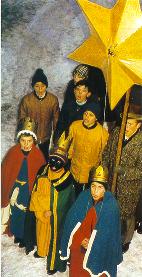 The custom of the Star Singers, reminiscent of the travel of the
Three Kings is still very much alive in Bavaria and Austria. Beginning
with New Years and through January 6, children dressed as the kings, and
holding up a large star, go from door to door, caroling and singing a
Three Kings' song. For this they receive money or sweets. Formerly
the collected donations went to unemployed craftsmen and veterans, today
.
The custom of the Star Singers, reminiscent of the travel of the
Three Kings is still very much alive in Bavaria and Austria. Beginning
with New Years and through January 6, children dressed as the kings, and
holding up a large star, go from door to door, caroling and singing a
Three Kings' song. For this they receive money or sweets. Formerly
the collected donations went to unemployed craftsmen and veterans, today
. 