Saint Andrew the Apostle, the brother of Saint Peter, was martyred under
the Emperor Nero and is remembered on November 30, traditionally
considered the date of his martyrdom in 60 A.D. He is said to have
died on a diagonally transversed cross which the Romans sometimes
used for executions and which, therefore, came to be called St. Andrew's
cross.
St. Andrew is the patron saint of Scotland and in Scotland the entire
day is devoted to him. It may begin with a community breakfast, followed
by a religious service and a lecture, and later a series of musical and
dramatic presentations, presented throughout town.
Connected with Advent, which begins on the first Sunday after November
26, St. Andrew's also marks the opening of Christmas Markets, and many
Midwinter customs and folk superstitions are connected to this day.
It is the first of the "Klöpfelnächte."
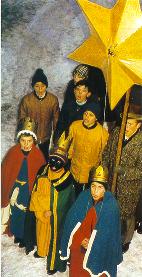
"Anglöckeln, Klöpflgeher, Glöcklisinger, Kurrendesänger,
Bosseln" describe the groups of Christmas carolers or star-singers
from various German regions who walk from door to door. After knocking
(klopfen) or ringing the doorbell (Glocke) they sing for gifts. Some
sources say that this symbolizes the angel bringing the message of
Christ's birth to Mary; others ascribe it to earlier rituals of driving
out evil spirits with loud knocking sounds.
Whatever the symbolism, for a long time it was one of the few ways by
which the poor could earn a meal during the winter season. The duration
of this tradition varies widely and can last until Epiphany (January 6).
Today it is mostly performed by children, who try to collect gifts for
themselves or donations for some charity.
Saint Andrew is also important as the patron saint of marriage and
fertility for girls. St. Andrew's was a traditional time of "oracles"
for girls who pray to the Saint for a husband and wish to receive some
visible assurance that their prayers have been heard. For example, a
girl wishing to marry could throw a shoe at a door around midnight on
Nov. 29. If the toe of the shoe pointed in the direction of the exit,
then she would marry and leave her parents' house within a year. Or
she could peel a whole apple without breaking the peel and throw the
peel over the shoulder. If the peel formed a letter of the alphabet,
then this suggested the name of her future groom. So, the night of
November 29 was the night to look into the future and find out one's
fate.
Ruth Reichmann
Max Kade German-American Center IUPUI
From Goethe's Faust, der Tragoedie erster Teil, Vor dem Tor
BÜRGERMÄDCHEN:
Agathe, fort! ich nehme mich in acht,
Mit solchen Hexen öffentlich zu gehen;
Sie ließ mich zwar in Sankt Andreas' Nacht
Den künft'gen Liebsten leiblich sehen-
 "Anglöckeln, Klöpflgeher, Glöcklisinger, Kurrendesänger,
Bosseln" describe the groups of Christmas carolers or star-singers
from various German regions who walk from door to door. After knocking
(klopfen) or ringing the doorbell (Glocke) they sing for gifts. Some
sources say that this symbolizes the angel bringing the message of
Christ's birth to Mary; others ascribe it to earlier rituals of driving
out evil spirits with loud knocking sounds.
"Anglöckeln, Klöpflgeher, Glöcklisinger, Kurrendesänger,
Bosseln" describe the groups of Christmas carolers or star-singers
from various German regions who walk from door to door. After knocking
(klopfen) or ringing the doorbell (Glocke) they sing for gifts. Some
sources say that this symbolizes the angel bringing the message of
Christ's birth to Mary; others ascribe it to earlier rituals of driving
out evil spirits with loud knocking sounds. 