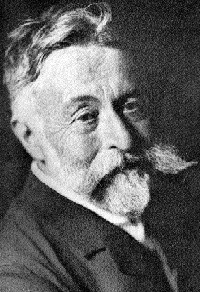
Like so many of the great makers of nineteenth-century American art, Nast
was a foreigner. He was born in 1840 in the little German town of Landau.
His father was a musician, who played trombone in a military band. He was
also a liberal of the great generation of 1848, and, with his family, he
fled reaction to come to New York. Nast was a pure product of the German-
American culture that in many ways dominated New York then, and still
survives, in fragments, up around East Eighty-sixth Street. It was a
culture built around sacredness of concert music, particularly Beethoven
(Nast's father was a member of the Philharmonic Society, and, odd as it
seems now, after a hundred years of darker views of Germanness, around
a sense of comfort that eventually produced the American cult of Christmas.
In Nast's generation, it was the Germans who brought warmth and music to
a parched and tinny American Protestantism.
More important, Nast remained a German artist in the same manner that
Audubon remained French. He had a distinctly German combination of
liberal feeling and prim, self-righteous Protestant offense at excess;
it is not always easy to separate the anti-corruption from the anti-
Catholic feeling in his mature cartooning. ...
Charles J. James
THOMAS NAST EXHIBIT
There is a wonderful exhibit about Thomas Nast every year in Morristown, New Jersey. Morristown
has a beautiful historic section in which one can visit Macculloch Hall,
which in turn houses an extensive collection of Thomas Nast drawings. The
museum is quite proud of this collection and displays it every year under
a different theme. Furthermore, the house in which the family of Thomas
Nast lived is diagonally across from Maculloch Hall and one can see the
outside, but not visit the interior since it is privately owned. I take students every year in October as part of the German-American Day celebration to Morristown and the Thomas Nast exhibit, followed by an
Oktoberfest luncheon which can be had in many area restaurants and pubs.
It is always a great field trip and the students are surprised to learn
that Thomas Nast was actually born in Germany. They study about him in
their history classes, but nowhere is it mentioned that he is German
born. This year I had to bring a pamphlet to the history teacher, because
he was not convinced by what his students told him upon their return.
Sie möchten wissen, wie ich den Ausflug in den
Unterricht einbinde. Ich benütze die Gelegenheit des 6. Oktober als
Ausgangspunkt für das Thema Deutsch-Amerikaner im dritten Jahr Deutsch.
Wir stellen eine Liste zusammen mit kurzen deutschen Beschreibungen für
jede Person. Damit rechtfertige ich die Zeit, die wir damit verbringen, denn
es hilft neue Vokabeln und Ausdr%uuml;cke zu lernen. Wenn alle diese
Beschreibungen gut lesen und aussprechen können, gibt es eine Kurzarbeit.
Danach kommt der Ausflug mit einem Mittagessen (Octoberfest luncheon) in der
Nähe des Museums. Meistens ist das Wetter im Oktober noch recht schön,
so auch das hilft den Ausflug angenehm und erinnerungswert zu machen.
Zurück in der Schule gibt es dann einen Aufsatz über Thomas Nast
zu schreiben. Wir machen zuerst eine Kopie ins Unreine auf Deutsch. Ich
verlange nur 100 Wörter, aber für manche Schüler ist auch das
schon ein anspruchsvolles Ziel. Ich lese diese ersten Kopien, unterstreiche
die Fehler und mache kurze Notizen, wenn etwas fehlt oder unklar ist. Danach
gibt es ein Korrekturschreiben, das wir in der Klasse beginnen und zu Hause
fertiggemacht wird. Die Schüler bekommen 30 Punkte für die erste
Fassung und eine Buchstabenzensur für die endgültige Fassung, die
einer Prüfung gleichkommt. Somit habe ich Schreiben auf Deutsch
durchgeführt, während wir auch das kulturelle einbezogen haben.
Als Bonus-Aufgabe lasse ich die Schüler Information ¨ber Wernher
von Braun finden, über den ich nur einen kurzen Paragraphen auf
English haben möchte. Der Grund dafür ist, dass ich keinen Abdruck
vom Computer haben möchte, die Schüler müssen es verkürzt
in einem Paragraphen in ihrer eigenen Handschrift einreichen, so weiss ich
wenigstens, dass sie die Information gelesen haben. Ich habe vor, das Buch
über die Deutsch-Amerikaner (Heimat Nordamerika)von unserer Bibliothek bestellen zu lassen,
dann könnte ich jedem Schüler eine Person zuweisen, über die
sie dann berichten müssten.
Margot Barke
The book Heimat North America can be purchased through
NCSA LITERATUR at the discount price of $40 (includes delivery).
FURTHER ONLINE RESOURCES
Thomas Nast, the man who, along with Clement Moore, created our current
image of Santa Claus, was featured in the New Yorker (December 15, 1997).
The issue was devoted to cartoons and what would be more appropriate to
cartoons and to Christmas than to tell the story of Thomas Nast Here is
an excerpt (pp. 84-102) from the article by Adam Gopnik.
Madison, Wisconsin

Roxbury High School
Succasunna, N.J. 07866
NCSA LITERATUR
430 Kelp Grove Rd.
Nashville, IN 47448.
Return to Forty-Eighters or German-American Page.Created December 21, 1997