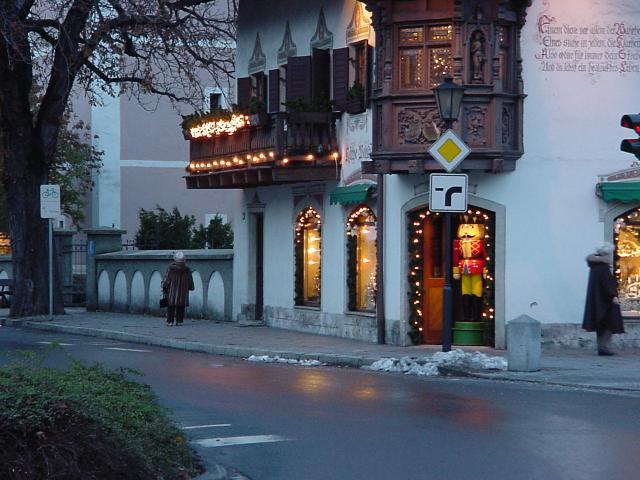
Garmisch, December 1, 2001. Courtesy of Frank Housholder.
The combination of a useful tool and a figural form with a human appearance must have been well accepted by the mid-18th century. In the toy making center of Sonneberg in the Thuringian Forest there was mention in 1735 of "nut-biters" that operated according to the principles of leverage. These nut-biters were described as sturdy, energetic forms with large heads. Two moving arms on the back of the head allowed the lower jaw to push the nut against the upper jaw. In a carnival parade in 1783, students from Freisingen, Germany presented large models of Berchtesgaden wares, including a nut-biter in the form of a little man whose mouth and stomach were one and the same. In 1971 Nutcrackers were listed in the storehouse records of the Berchtesgaden (Bavaria) wholesaler Anton Wallner. By the time the Brothers Grimm put together their first dictionary of "High German" (the dictionary was begun in the 1830s), the term Nussknacker was defined as "often in form of a misshaped little man, in whose mouth the nut, by means of a lever of screw, is cracked open."
The literary career of the nutcracker began with the 1816 publication of E.T.A. Hoffmann's fairy tale "Nussknacker und Mausekönig," a children's book that helped bring the nutcracker into a broader popularity. In the spirit of the developing Biedermeier period, a time when the importance of the family and children was beginning to be emphasized, Hoffmann vividly depicted a sympathetic soul: "Under the Christmas tree a very excellent little man became visible that stood there still and modestly. He waited as if they would all come to him." The job of the nutcracker was to work hard for the children of the family by
The Nutcracker King would appear again 1891 as an enchanted prince in Peter Tschaikowsky's Nutcracker Suite and continue to win children's hearts. The ballet contributes to the ever- increasing popularity of the nutcrackers as collectible objects. Thirty-five years after the publication of E.T.A. Hoffmann's classic, the nutcracker reappeared as a central character in Heinrich Hoffmann's story "King Nutcracker and the Poor Reinhold" (1851). In this story the
The nutcracker did not always play the role of the good-hearted fairy tale king. More often he wore a monk's robe or was made into the form of a mean-looking policeman, a Turk, master of the watch, a cavalry man or some other grotesque helmeted figure with a long nose. He appeared, for example, as a caricature of Napoleon on a 1813 Parisian picture-sheet. By the end of the 19th century he appeared almost consistently in the catalogs of the toy wholesalers as a representative of the contemporary authorities. It must have been fascinating for both manufacturer and user to transfer the troubl- some task of the nutcracker to particularly unloved figures. What started out as a practical tool often ended up as an expression of light irony and a social critique by the common people.
Although nutcrackers from the Erzgebirge region were being sold at the Dresden Fair by 1745, the birthday of the world-renowned figural nutcrackers from the village of Seiffen must have taken place around 1870. The "father" of the Erzgebirge nutcrackers is thought to be Friedrich Wilhelm Füchtner (1844-1923). Füchtner's figures became the prototypes for many other nutcrackers from the region. Füchtner's basic nutcracker form was turned on a lathe, with the turned parts made of pine, beech and alder. Minimal decoration based on the contrasting colors of red and gold or blue and orange resulted in a simple but effective representation. The policeman, the soldier, and the forester, all very simple characters, are the earliest known forms. The basic production of all the figures remained the same, with only the hat, color, decorative details, and accessories varying from figure to figure. The production of Füchtner nutcrackers has been carried on by the next four generations: Albert Füchtner (1875-1953), Kurt Füchtner (1903-1970), and by Werner Füchtner (born in 1930) and his sons.
A renaissance of nutcracker production occurred in the Seiffen area after 1960, led by crafts people who maintained the old traditions. A "Husar" (cavalry man) was developed by Henry Lippmann (1926-1971) and a Danish guardsman and soldier with a spiked helmet by Walter Wenzel. Other producers included Richard Gläser, Walter Trünker (Neuwernsdorf) and Rudolf Ender (Borstendorf). The old traditions have been especially maintained by the demonstration workshop of the EG Seiffener Volkskunst Company. Visitors can visit this very small factory and watch the highly skilled crafts people as they produce the various nutcracker forms.
For almost three centuries Seiffen was at the center of one of the world's most important toy-making production and export regions. During the difficult years under communism, many of the village's crafts people struggled to maintain their personal independence and continued to pass down the toy making traditions of their forefathers. With the reunification of Germany, it is again possible to visit this once remote corner of the Erzgebirge Mountains. The Erzgebirge Toy Museum, with over 3,000 examples of toys and Christmas folk art on display, is the central cultural attraction of the village. The Erzgebirge open-air Museum with its restored and furnished buildings provides visitors with an interpretation of the folk culture of the region. Special advent music programs are given each Sunday during the season in the historic baroque church. Almost every one of the small Erzgebirge houses of the village contains a toy maker's workshop, and visitors are encouraged to visit the homes and watch over the shoulders of the crafts people. The whole village becomes a toy store during the Advent season, when a Christmas market is held each Advent Saturday on the streets of the village. Additional information is available from the local tourist bureau: Fremdenverkehrsamt, 09548 Kurort Seiffen, Germany. The telephone number from outside Germany is country code 49, area code 37362, local telephone number 218 (or 219).
Written by Dr. Konrad Auerbach, Museum Director and Mary Audrey Apple, Guest Curator for the opening of a special Christmas Exhibit of the Erzgebirge Toy Museum Seiffen, December 28, 1992.
Every Christmas, Lillian Doane of Jasper, stages "The Nutcracker Suite" in her home. It's not the play that Doane produces. She displays her collection of more than 100 nutcrackers--carved wooden figures of mostly traditional German characters.
The nutcrackers in her collection range from a few inches tall to more than a foot. "I got interested on my first trip to Germany in the early 1970s" she says. "I saw a nutcracker in a little shop and bought it." Most of the German nutcrackers are military-type figures or something similar, she says.
"Many are being made in China now and are more personal," she says, picking up a nutcracker of Dorothy from "The Wizard of Oz." Others include Peter Rabbit, Puss'n Boots, a drum major, Santa Claus, a chimney sweep, Halloween figures and an old-time toy-maker with wire-rimmed glasses.
Nutcrackers stand at attention at nearly every table in her living room and dining room. "Originally, they were used for cracking nuts," she says holding a nutcracker of a soldier and working its lever. "It's a very old German tradition. It was a way for people to poke fun at the king or their rulers by making nutcracker figures of them" she says.
The nutcracker motif extends to more than just the figures. She wears a sweater with a nutcracker embroidered on it; there are potholders and towels in her kitchen with nutcracker designs. "I just like them," she says laughing. "If I get any more, I'll have to get a bigger house."
Excerpted from David Kunz's article in the "Herald," Jasper, Dec. 20, 1995
OTHER RESOURCES
KRIPPEN - MANGERS - CRECHES - NATIVITY SCENES
Return to Christmas Page
